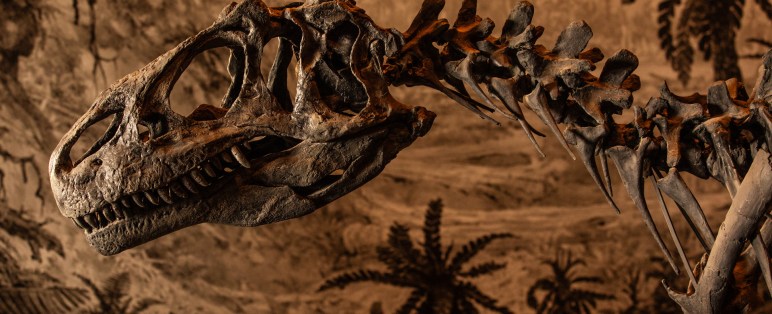
Long before the Tyrannosaurus rex ruled the Late Cretaceous, the apex predator of the Late Jurassic landscape was Allosaurus. Spanning from approximately 157 to 145 million years ago, this massive, carnivore has captured the human imagination for well over a century (Burigo & Mateus, 2024). However, the story of how Allosaurus went from a few shattered bone fragments to one of the most thoroughly understood dinosaurs in the world is a dramatic tale of scientific rivalry, taxonomic confusion, and massive fossil bonanzas.
The Bone Wars and the First Fragments (1870s)
The history of Allosaurus is deeply intertwined with the infamous “Bone Wars”—a fierce 19th-century rivalry between paleontologists Othniel Charles Marsh and Edward Drinker Cope.
The very first verified Allosaurus fossils were collected as early as 1869 by local residents in Middle Park, Colorado, who mistook them for petrified horse hoofs. They were sent to Joseph Leidy, who provisionally named the animal Antrodemus valens. Because the material was so fragmentary, the name was later largely abandoned (Paul & Carpenter, 2010).
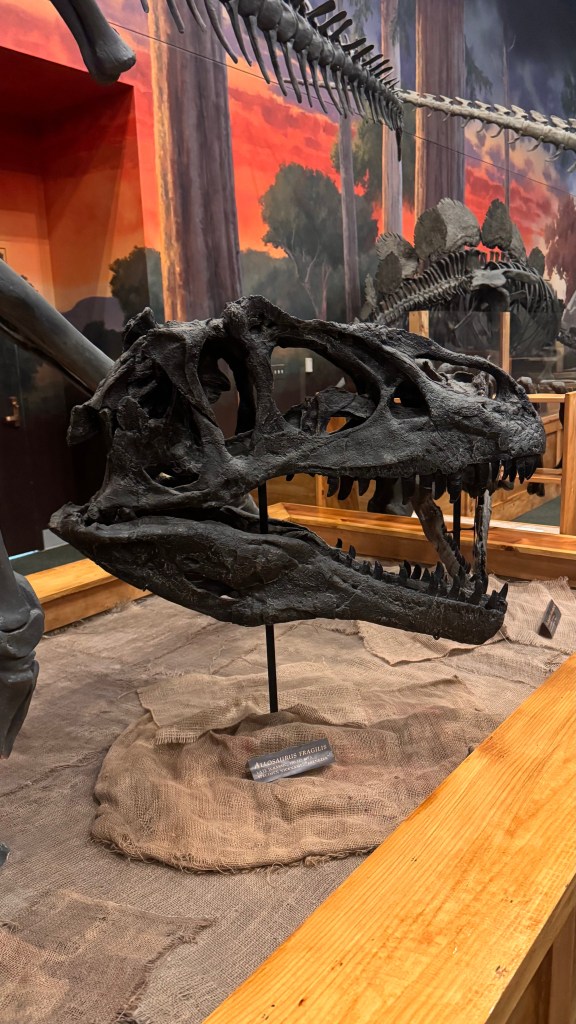
The official debut of the genus came in 1877. Othniel Charles Marsh described a highly fragmentary specimen—consisting of a few vertebrae, a rib, and foot fragments—discovered in the Morrison Formation of Garden Park, Colorado (Evers et al., 2020). Marsh coined the name Allosaurus fragilis (Marsh, 1877).
“Allosaurus” translates to “different lizard,” chosen because its vertebrae were distinctively lighter and lighter-structured than those of other dinosaurs known at the time.
“fragilis” highlighted the delicate, hollow quality of these same structural bones.
Not to be outdone, Edward Drinker Cope discovered his own theropod remains shortly after, naming them Creosaurus and Epanterias. Decades later, scientists realized Cope’s discoveries were simply exceptionally large specimens of Marsh’s Allosaurus.
Unlocking the Treasury: The Cleveland-Lloyd Dinosaur Quarry
For decades after its naming, a truly complete picture of Allosaurus eluded scientists due to the scarcity of articulated skeletons (Paul & Carpenter, 2010). That changed dramatically in the 20th century with discoveries in the state of Utah.
Though initial scientific collecting began around 1929, major excavations throughout the mid-20th century exposed a massive paleontological treasure trove at the Cleveland-Lloyd Dinosaur Quarry in Emery County, Utah (Evers et al., 2020). The quarry presented a unique taphonomic puzzle: thousands of disarticulated bones jumbled together, with an overwhelming 80% of the predatory remains belonging to Allosaurus fragilis.
At least 46 individual Allosaurus specimens, ranging from small juveniles to massive adults, were recovered from this single site (Evers et al., 2020). This bounty allowed paleontologist James Madsen to publish a monumental, definitive osteology of the genus in 1976, meticulously mapping out every individual bone and creating the standard anatomical reference blueprint for the species.
“Big Al” and the Window into Paleo-Pathology
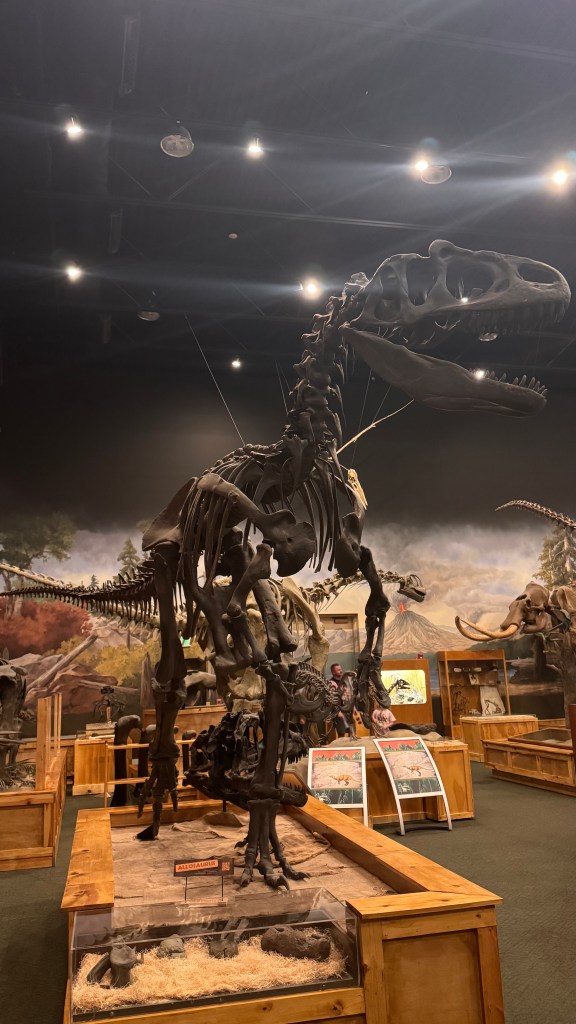
In 1991, the history of Allosaurus research shifted from analyzing scattered populations to chronicling the dramatic life of a single individual. A team of paleontologists in Wyoming discovered an incredibly complete, beautifully articulated Allosaurus skeleton nicknamed “Big Al” (MOR 693). A few years later, a second nearly complete skeleton, “Big Al 2” (SMA 0005), was unearthed nearby (Foth et al., 2015).
These two specimens provided unparalleled insights into the grueling life of a Jurassic predator. “Big Al” and “Big Al 2” exhibited an astonishing number of pathologies—including multiple broken ribs, fractured toes, and severe bone infections (Foth et al., 2015). These injuries told a vivid story of survival, implying that Allosaurus lived an active, highly dangerous predatory lifestyle, and likely suffered severe trauma while hunting massive sauropods or defending territory.
Modern Taxonomy and International Footprints
While Allosaurus has long been celebrated as the definitive American dinosaur, modern paleontology has expanded its horizons across the globe.
The European Connection
Fossils discovered in the Lusitanian Basin of Portugal definitively proved that Allosaurus traversed ancient land bridges across a young, proto-North Atlantic Ocean (Burigo & Mateus, 2024). For years, the classification of these European specimens sparked intense debate. However, recent cranial examinations and phylogenetic analyses have brought clarity to the genus.
How Many Species Exist?
Today, mainstream consensus recognizes three distinct, valid species within the genus Allosaurus (Burigo & Mateus, 2024): Allosaurus fragilis – North America (Morrison Formation), Allosaurus jimmadseni – North America, Allosaurus europaeus – Europe (Portugal)
From a handful of delicate, fragmented bones discovered during a bitter 19th-century feud, Allosaurus has risen to become one of the most comprehensively studied apex predators in paleontology. Its rich history of discovery continues to teach us not only how these magnificent creatures ruled the Jurassic, but how they lived, suffered, and adapted across a changing prehistoric world.
References
Burigo, A., & Mateus, O. (2024). Allosaurus europaeus (Theropoda: Allosauroidea) revisited and taxonomy of the genus. Diversity, 17(1), 29. https://doi.org/10.3390/d17010029
Evers, S. W., Foth, C., & Rauhut, O. W. M. (2020). Notes on the cheek region of the Late Jurassic theropod dinosaur Allosaurus. PeerJ, 8, e8493. https://doi.org/10.7717/peerj.8493
Foth, C., Evers, S. W., Pabst, B., Mateus, O., Flisch, A., Patthey, M., & Rauhut, O. W. M. (2015). New insights into the lifestyle of Allosaurus (Dinosauria: Theropoda) based on another specimen with multiple pathologies. PeerJ, 3, e940. https://doi.org/10.7717/peerj.940
Paul, G. S., & Carpenter, K. (2010). Case 3506 Allosaurus Marsh, 1877 (Dinosauria, Theropoda): Proposed conservation of usage by designation of a neotype for its type species Allosaurus fragilis Marsh, 1877. The Bulletin of Zoological Nomenclature, 67(1), 53-56. https://doi.org/10.21805/bzn.v67i1.a7
 The Jurassic Files